| Service |
Study of interactions in protein samples |
|
| Goal |
Determination of protein-protein, protein-DNA, or protein-ligand interactions |
|
|
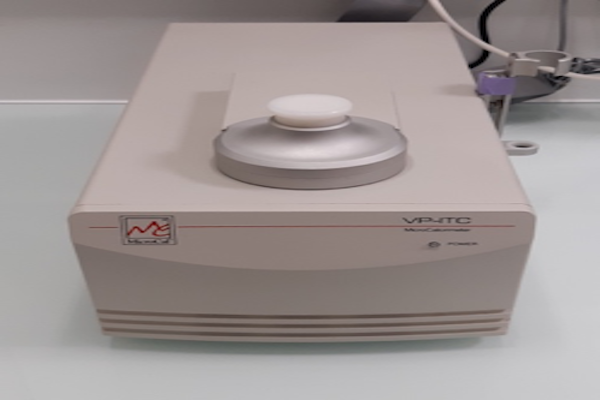
Different instruments are available at the CBS to measure interactions with proteins. The main applications of this technique are:
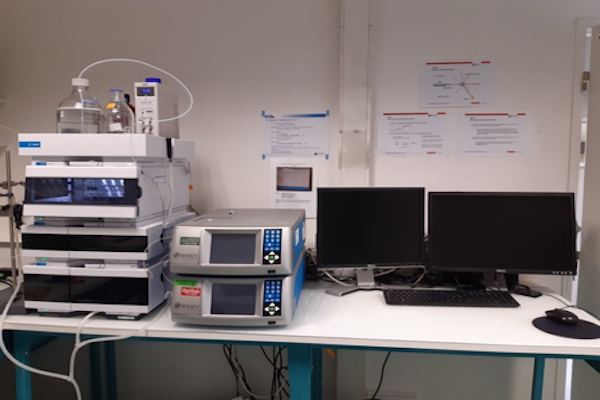
SEC-MALLS technique can also be used to study macromolecular complexes. It allows to define the absolute molecular mass of the protein or complex analyzed regardless their size and conformation. It includes exclusion chromatography (SEC) coupled online with a measurement of UV absorbance, laser light scattering (LS) and refractive index (RI). The proteins are separated by exclusion chromatography, the light scattered by the proteins is directly proportional to their molecular weight and their concentration. This technique also makes it possible to determine stoichiometry in a complex. The Thermal Shift Assay (TSA) technique measures the denaturation temperature variation in a protein sample during a rapid temperature gradient in function of experimental conditions. The fluorescent dye Sypro Orange is used to measure the exposure of the protein hydrophobic regions during its denaturation. Like that, TSA can be used to screen potential interactions between a protein and different ligands (peptides, chemical library). The Nano Differential Scanning Fluorimetry (NanoDSF) is a label-free technique that monitors the intrinsic fluorescence of proteins—mainly from tryptophan and tyrosine residues—while the temperature is gradually increased. As the protein unfolds, changes in fluorescence allow determination of its thermal stability, typically expressed as the inflection temperature (Ti). In the context of protein–ligand interactions, binding is detected through shifts in Ti: ligand binding that stabilizes the protein leads to an increase in Ti, whereas destabilization results in a decrease, with the magnitude of the shift providing insight into the interaction. The Bio-Layer Interferometry (BLI) is an optical analytical technique used to study biomolecular interactions in real time. It relies on the interference pattern of white light reflected from two surfaces: an internal reference layer and a biological layer where molecules are immobilized. When binding occurs on the sensor surface, the optical thickness changes, leading to a measurable shift in the interference pattern. This shift is directly proportional to the amount of biomolecule bound. BLI does not require labeling of the interacting partners, making it a label-free method. It is commonly used to determine kinetic parameters such as association and dissociation rates. Additionally, it allows calculation of binding affinity (KD). The technique is widely applied in drug discovery, protein analysis, and antibody characterization. (Available in June 2026) |
||
|
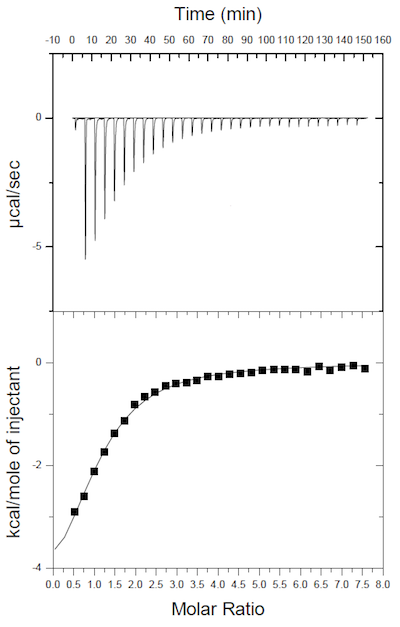
Example of interaction measurement between a protein of interest and a synthetic ligand with ITC 200 |
||
| Equipement |